If you’ve ever walked into a bedroom and immediately felt calmer without knowing why, chances are the room was arranged with intention. That’s really all feng shui bedroom design is paying attention to how a space makes you feel, and then adjusting the layout, the furniture, and the small details until the room supports rest instead of working against it.
I get asked about this more than almost any other room in the house, and for good reason. We spend roughly a third of our lives asleep, and the bedroom is usually the most personal, private corner of a home. When it’s cluttered, awkwardly arranged, or filled with the wrong energy, it shows up in how you sleep, how you feel about your relationships, and even how rested you look in the morning. So before you repaint a wall or buy a new headboard, it helps to understand the handful of principles that actually move the needle starting with the single most important piece of furniture in the room: your bed.
What “Good Feng Shui” Actually Means in a Bedroom
Feng shui translates loosely to “wind and water,” and at its core it’s about the flow of chi the life force energy that’s said to move through every space we live in. In a bedroom, the goal isn’t to fill the room with symbols or follow a rigid checklist. It’s to remove the things that block or disturb that flow (clutter, sharp angles, harsh light) and bring in the things that support it (softness, balance, natural materials). Once you see it that way, a lot of the “rules” start to make a lot more sense they’re really just good design sense dressed in older language.
Before making any changes, it’s worth doing a simple declutter. A nightstand drawer stuffed with old receipts or a closet you can’t close properly creates a kind of visual noise that follows you into sleep, even if you’re not consciously aware of it. Clear the surfaces, donate what you don’t need, and give yourself a clean foundation to work from.
Feng Shui Bedroom Layout: Start With the Bed
Every feng shui bedroom layout conversation begins in the same place the position of the bed. This is the anchor of the entire room, and where you place it will shape how the rest of your furniture, lighting, and décor should be arranged around it.
The Commanding Position
In feng shui, the ideal spot for a bed is what’s called the “commanding position.” This means that when you’re lying down, you can see the bedroom door without being directly in line with it. You want a clear view of who or what is entering the room, but you don’t want your feet pointing straight at the doorway.
This single adjustment in bed position feng shui is said to promote a sense of safety and control, which in turn supports deeper, more restful sleep. People who unknowingly sleep with their back to the door, or directly in its line, often report feeling more anxious or on edge without being able to pinpoint why and once they reposition the bed, that unease tends to settle.
If your room’s layout genuinely doesn’t allow for the commanding position a common issue in small apartments or oddly shaped rooms you don’t have to force it. A well-placed mirror that reflects the doorway from your line of sight while lying in bed can offset the same effect. It’s a simple workaround that a lot of interior designers use even without knowing the feng shui reasoning behind it.
Anchor the Bed Against a Solid Wall
Wherever possible, the head of the bed should rest against a solid wall rather than floating in the middle of the room or sitting beneath a window. A solid wall behind you provides a sense of backing and support almost like having a mountain at your back. Beds placed under windows, on the other hand, tend to feel exposed, and drafts or light leaking in can quietly disrupt sleep quality over time.
Leave Equal Space on Both Sides
A balanced feng shui bedroom layout gives equal breathing room on either side of the bed, even if you sleep alone. This is one of the most overlooked pieces of advice, but it matters: a bed pushed hard against one wall, with no room to walk around one side, is thought to symbolically shut out a partner (current or future) and can make the room feel lopsided and cramped. If your square footage is tight, even a narrow gap on both sides is better than none at all.
Feng Shui Bed Placement: The Details That Matter
Once the bed is in a workable spot, a few more details around feng shui bed placement are worth double-checking.
- Avoid positioning the bed directly under a ceiling beam, sloped ceiling, or air vent. Heavy overhead structures are said to create a subtle sense of pressure while you sleep, and air conditioning vents blowing directly onto the bed can disrupt both your energy and your physical comfort.
- Skip the “death position.” This is the somewhat dramatic feng shui term for placing the bed directly in line with the door, feet pointing straight out of it. It’s linked to restlessness and vulnerability, so even a slight diagonal placement is preferable.
- Always use a solid, well-secured headboard. A headboard represents support in life professionally, romantically, and personally. Choose one with soft or rounded edges rather than sharp angles or metal bars, and make sure it’s firmly attached so it doesn’t wobble against the wall.
- Keep the space under the bed clear. Storage boxes and old belongings shoved under the bed frame are believed to trap stagnant energy directly beneath you as you sleep. If you’re using an under-bed storage system, keep it minimal and organized rather than crammed full.
Bedroom Feng Shui Rules Beyond the Bed
Bedroom feng shui rules don’t stop at the bed itself the objects and furniture around it play a role too.
Mirrors are one of the most debated topics in feng shui, and for good reason. A mirror that directly faces the bed is generally discouraged, since it’s believed to amplify energy and disturb sleep, and in older feng shui schools it’s associated with introducing tension into a relationship. If you love a mirror in your room, angle it so it doesn’t reflect the bed directly, or place it inside a closet door instead.
Electronics TVs, laptops, and even phones charging on the nightstand are considered disruptive because they keep the mind subtly “on,” even while you’re trying to wind down. If removing them entirely isn’t realistic, at minimum switch them off completely rather than leaving them on standby, and try charging your phone across the room instead of within arm’s reach.
Work materials have no real place in a bedroom. A desk piled with paperwork in the corner of your room quietly reminds your nervous system of deadlines and to-do lists right up until the moment you close your eyes. If you work from home and space is tight, a closing cabinet or a room divider can help visually separate “work” from “rest.”
Sharp corners and pointed objects glass-top nightstands, angular shelving, decorative swords or blades are thought to create “cutting” energy. Rounded furniture edges are gentler on the eye and, practically speaking, safer to bump into in the middle of the night.
Standing water features or artwork depicting oceans, rivers, or rain are typically avoided in the bedroom, even though water is considered lucky in other rooms of the home. In a bedroom specifically, it’s believed to introduce restlessness rather than calm.
Feng Shui Bedroom Colors for Rest and Balance
Color has a bigger effect on sleep than most people give it credit for, and feng shui bedroom colors lean heavily toward tones you’d naturally find outdoors.
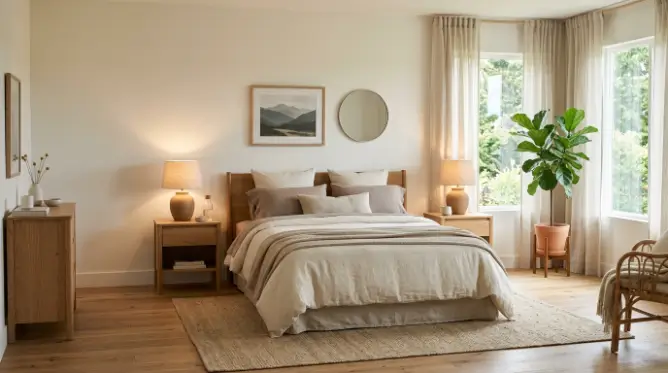
Soft, muted, skin-like tones warm creams, soft taupe, gentle browns, and pale terracotta are considered the most grounding and universally calming choices for bedroom walls. These earthy neutrals support a slower, quieter energy that’s ideal for winding down.
Peach and blush tones are said to be especially good for attracting romantic energy, but they’re best used sparingly a throw pillow, a piece of art, a soft textile rather than covering an entire wall, since too much of this color is thought to invite more romantic attention than you bargained for.
Stark white, while popular in modern interior design, is worth using carefully in a bedroom. Bright white belongs to the metal element in feng shui, which is mentally stimulating rather than restful, so if you love a lighter palette, lean toward warm off-whites or ivories instead of a cool, clinical white.
Deep, saturated colors like true black or intense red can work as small accents, but painting an entire bedroom in either is generally discouraged, since both can feel overstimulating or heavy over long stretches of time.
Feng Shui Bedroom Décor and the Five Elements
Good feng shui bedroom décor isn’t about filling the room with symbolic trinkets it’s about representing the five elements (wood, fire, earth, metal, and water) in a way that feels balanced rather than themed.
- Wood shows up naturally through furniture a wooden bed frame, dresser, or nightstands and through the color green.
- Fire can be brought in subtly with candles, warm lighting, or accents in red, orange, or pink.
- Earth is represented through natural materials like clay, stone, and ceramic, along with sandy or terracotta tones.
- Metal appears in decorative frames, sculptural accents, or metallic hardware on furniture.
- Water, unlike the other elements, is usually left out of the bedroom entirely, or represented only very subtly through color rather than an actual water feature.
Beyond the five elements, a few sensory details go a long way. Soft, breathable bedding in natural fibers like cotton or linen feels better against the skin and supports a more restful night. A pair of matching nightstands and lamps rather than mismatched pieces reinforces balance, and is traditionally thought to support partnership, even in a single person’s bedroom. Blackout curtains or well-fitted blinds help regulate the yin (restful, quiet, dark) energy needed for sleep at night, while still letting in bright yang light in the morning.
Live plants are lovely in most rooms of a home, but in the bedroom it’s worth using a light hand. Plants carry fast-growing, active “yang” energy, which can work against the slower, restful atmosphere you’re trying to build. If you love greenery in your room, one or two low-maintenance plants are plenty save the larger jungle-style collection for your living room.
Positive Energy Placement in a Feng Shui Bedroom: Pulling It All Together
Once the bed, colors, and major furniture are sorted, positive energy placement in a feng shui bedroom really comes down to layering in small, intentional touches:
- Keep a glass of water with a slice of lemon on your nightstand and drink it each morning a small feng shui ritual that also happens to be good for you.
- Use a diffuser with calming scents like lavender or jasmine for an hour before bed, rather than running it all night.
- Add a soft white-noise machine if outside sound tends to disrupt your sleep.
- Choose art and objects that genuinely make you happy to look at feng shui puts a lot of weight on surrounding yourself with things that spark real joy rather than décor chosen purely to “look right.”
Small Bedroom Feng Shui Layout: Making the Most of Limited Space
A small bedroom feng shui bedroom layout comes with its own set of trade-offs, but the core principles don’t change you just have to prioritize.
If there isn’t room to center the bed with equal space on both sides, pushing one side gently against a wall is an acceptable compromise, as long as there’s still enough room to comfortably get in and out of bed on the other. Where floor space for two nightstands isn’t available, a slim floating shelf on one side can stand in for a nightstand without eating into walking space.
Multi-functional furniture is your best friend in a compact room a bed frame with built-in drawers, an ottoman that doubles as seating and storage, or a slim dresser that also works as a TV stand elsewhere in your home so it doesn’t need to live in the bedroom at all. Mirrored wardrobe doors can help a tight room feel larger and brighter, just be mindful of the earlier point about mirror placement relative to the bed.
Vertical storage tall, narrow shelving rather than wide dressers keeps the floor plan open, which matters more in feng shui than most people realize. An uncluttered floor allows energy (and, practically speaking, you, half-asleep at 2 a.m.) to move through the room freely.
Feng Shui Bedroom Layout by Room Shape
Not every bedroom is a perfect rectangle, and the shape of your room genuinely changes how you should approach the layout.
Rectangular rooms are the easiest to work with center the bed against the longer wall opposite the door for a natural commanding position with balanced space on both sides.
Square rooms sometimes make it harder to avoid placing the bed in direct line with the door. In this case, angling the bed slightly into a corner, rather than centering it dead-on, often solves the problem while still keeping the room feeling proportionate.
L-shaped rooms usually have a natural “alcove” that works well for the bed, tucked slightly out of the main sightline from the door which, conveniently, often creates the commanding position without any extra effort.
Rooms with a sloped ceiling (common in attic conversions) should avoid placing the bed under the lowest, steepest part of the slope. If there’s no way around it, a canopy or simple fabric draped from the ceiling above the bed can visually soften that sense of pressure.
What to Avoid in a Feng Shui Bedroom: Quick Reference
| Feng Shui Do | Feng Shui Don’t |
| Bed in the commanding position, facing the door | Bed directly in line with the door (“death position”) |
| Solid headboard with soft or rounded edges | Sharp-edged or wobbly headboards |
| Equal space on both sides of the bed | Bed jammed into a corner with no walking room |
| Muted, earthy color palette | Stark white or overly saturated walls |
| One or two calming plants, used sparingly | A jungle of plants around the bed |
| Soft, ambient lighting with dimmers | Harsh overhead lighting right before bed |
| A clutter-free space under the bed | Storage boxes and clutter under the bed |
| Artwork you genuinely love | Paintings of water, storms, or aggressive imagery above the bed |
Frequently Asked Questions
What is the best feng shui bed placement if my room only has one usable wall? If there’s only one wall long enough for the bed, prioritize the commanding position over centering it perfectly — you want to be able to see the door without being directly in line with it, even if that means one side of the bed sits a little closer to a side wall than the other.
Is it bad feng shui to have a desk in the bedroom? It’s not ideal, since a workspace introduces active, work-related energy into a room meant for rest. If you can’t avoid it, position the desk as far from the bed as possible and keep it tidy when you’re not using it, so it doesn’t dominate your view when you’re trying to sleep.
Can feng shui bedroom colors change depending on the direction the room faces? Advanced feng shui does factor in compass direction and a personalized bagua map, but for most people, sticking to warm, muted, skin-toned colors is a safe and effective starting point regardless of which way the room faces.
Does feng shui apply to shared or teen bedrooms too? Yes the same core principles (commanding bed position, solid headboard, clutter-free floor, calming colors) apply just as well in a teen bedroom or a shared room; you’re simply adapting the layout to fit two people or a smaller footprint.
Feng shui isn’t about turning your bedroom into a showroom of symbolic objects it’s about paying closer attention to how a space actually feels once you’re lying in it at the end of a long day. Start with the bed, get the layout and colors right, and let the smaller décor details follow from there. For more room-specific inspiration, take a look at our guides tocozy bedroom ideas,minimal bedroom decor,master bedroom inspiration, andsmall bedroom storage ideas or if your whole home could use a reset, our Home Edit Guide is a good place to start.