Choosing the right curtains starts with the measurements, not the fabric. A panel can look perfect in a photo and still end up too short, too narrow, or full of gaps once it’s hanging because curtain size depends on more than the glass. It depends on where the rod sits, how far it extends past the window, and how much fabric you want bunched into folds when the curtains are closed.
This guide walks through that whole process: the four measurements that actually matter, how to calculate width and length for any window, and what changes for blackout, cafe, pinch pleat, and other common curtain styles.
What You’ll Need
- A metal tape measure (cloth ones stretch and throw off the numbers)
- A pencil or pen and something to write on, or your phone’s notes app
- A step stool for tall windows
- A calculator
- A second person to hold the tape steady on wide windows
Write measurements down as you take them and label each one “window,” “rod,” “length” rather than trying to remember several numbers at once, especially if you’re doing more than one window.
The Four Measurements You Actually Need
Most curtain-sizing mistakes happen because these four measurements get mixed up. Keep them separate and the rest of the math is straightforward.
| Term | What it means |
| Window width | The width of the actual window or opening a reference point, not what you shop by |
| Rod width | The total width of the installed curtain rod, including any extension past the window |
| Curtain width | The total fabric width across all panels combined, based on rod width × fullness |
| Finished length | The distance from the curtain’s hanging point not necessarily the top of the fabric down to where it should end |
General rule: “Hanging point” and “top of the fabric” aren’t always the same spot. Rod-pocket curtains hang from the fabric’s top edge, but rings, hooks, clips, tabs, and pinch pleats all attach a little lower. Whatever hardware you’re using, measure length from where the curtain actually catches on the rod not from the top of the panel.
Step 1: Measure the Window and Decide Where the Rod Goes
Measure width at the top, middle, and bottom of the window frames aren’t always perfectly square, and it’s worth knowing if yours is off. While you’re there, check for anything that might get in the way of the rod or the curtains: handles, cranks, deep trim, a radiator, an outlet, a light switch, or a vent.
Next, decide on mounting. This affects both how far the rod extends and how much of the wall the finished curtains will cover.
| Inside mount | Outside mount | |
| Placement | Within the window frame | On the wall, around the window |
| Coverage | More limited | Can reduce edge gaps |
| Look | Neat, fitted | Fuller, more decorative |
| Common uses | Cafe curtains, small kitchen windows | Living rooms, bedrooms, blackout curtains |
As a starting point, 6–10 inches of extra rod length on each side works for many windows. The right amount really depends on wall space, curtain thickness, and how much of the window you want exposed when the curtains are open, so treat that range as a starting point rather than a fixed rule.
Rod height follows the same logic. A common starting point is 4–6 inches above the window frame. If you want a taller, more dramatic look, you can mount the rod higher, closer to the ceiling. Whatever height you choose, mark it with a level before drilling a rod that’s even slightly off level is easy to spot once curtains are hanging.
Step 2: Calculate Curtain Width
The key is to base curtain width on the area the rod covers, not the glass. Once you know the rod width, multiply it by your desired fullness how much fabric bunches into folds when the curtains are closed.
| Fullness | Appearance |
| 1.5× | Tailored, relatively flat |
| 2× | Full and versatile — the most common default |
| 2.5× | Richer, more decorative |
| 3× | Very full, often used for sheers |
These are planning figures, not fixed rules the header changes how much fullness actually looks right. Pinch pleats and grommets already build some shape into the top of the curtain, so they often look full at 2×. Flat rod-pocket panels or sheers usually need to go higher, toward 2.5×–3×, to get the same effect.
Here’s how that plays out across a few common window sizes, assuming an 8-inch rod extension on each side:
| Window | Rod width | 1.5× fullness | 2× fullness |
| 36″ | 52″ | 78″ | 104″ |
| 48″ | 64″ | 96″ | 128″ |
| 60″ | 76″ | 114″ | 152″ |
| 72″ | 88″ | 132″ | 176″ |
Take the 60-inch row as an example: a 76-inch rod at 2× fullness requires 152 inches of total fabric. Split across two panels, that’s about 76 inches of width needed from each one. If the panels you’re considering are narrower than that, you’ll need additional panels to reach the total which is exactly why wide windows at higher fullness often end up needing three or four panels instead of two.
Expert tip: Measure every window in a room separately, even ones that look identical. Small differences of an inch or two between “matching” windows are common and only become obvious once curtains are hanging.
Step 3: Measure Curtain Length
Length is measured from the curtain’s actual hanging point not the top of the window down to wherever you want the fabric to end.
Diagram, left to right: sill length, apron length, floor length, and puddled each ending progressively lower relative to the floor line.
Sill length: Ends at the windowsill. Works well for kitchens, laundry rooms, and windows above a counter or desk.
Apron length: A few inches past the sill. A relaxed, casual look without going all the way to the floor.
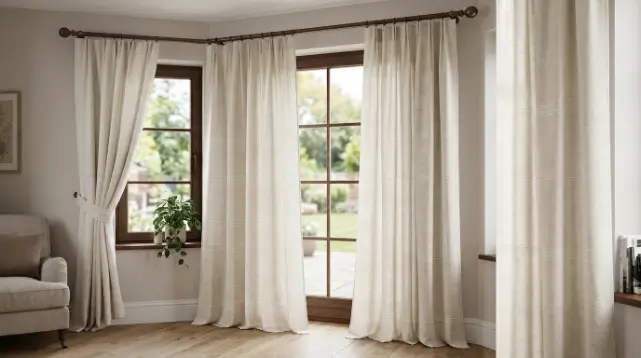
Floor length: Reaches the floor or sits just above it. The most versatile option for living rooms and bedrooms.
Puddled: Extends onto the floor. Decorative, but harder to keep clean with pets, kids, or a robot vacuum in the mix.
If you’re using rings, hooks, or a track rather than a rod pocket, measure to the actual point where the hook or ring meets the fabric not the top edge of the panel. That gap can be a few inches, and it changes the finished length.
Does Curtain Width Mean One Panel or Both?
This trips up a lot of online orders. If a listing says a curtain is 52 inches wide, check whether that’s per panel or for the pair. Two 52-inch panels give you 104 inches of total fabric a very different number than a single 52-inch panel would suggest. When in doubt, read the product description rather than assuming.
How to Measure for Blackout Curtains
Blackout curtains need a bit more attention because the goal isn’t just size — it’s reducing light. Light typically gets in through four places: both sides, the top, the bottom, and the center seam where two panels meet.
Diagram: light can enter around a blackout curtain at both sides, the top, the bottom, and the center seam where two panels meet.
An outside-mounted rod that extends beyond the window on both sides, combined with curtains that cover the window from top to bottom, can help reduce light gaps compared with an inside mount. Exact performance still depends on the window, the hardware, and the curtain’s own construction, so always check the product’s stated dimensions rather than assuming “blackout” means identical coverage across brands.
Blackout vs. room darkening: the two aren’t interchangeable. Blackout fabric is built to block very high levels of light; room darkening fabric reduces light but typically lets more through. Both vary by construction, so if light control is the priority, check the specific product rather than the category name alone.
How to Measure for Cafe and Kitchen Curtains
Cafe curtains cover part of a window often just the lower half while leaving the top open. Decide how much of the window you want covered first, then measure the width of the rod or mounting area and the length from the rod down to that point.
Kitchen windows often sit right above a sink or counter, so before ordering anything, confirm the curtain won’t hang into a faucet, cabinet door, or window handle. If the window is one you open regularly, leave enough clearance for the curtain to move without catching on the handle or frame. Short curtains, tiers, and cafe styles all tend to work better here than a full-length panel.
How to Measure for Pinch Pleat Curtains
Pinch pleat curtains can attach with rings, hooks, or a track, and each one puts the actual hanging point in a slightly different place relative to the top of the fabric. Decide on your hardware before measuring, then measure from where the hook or ring actually sits not the fabric’s top edge down to the floor or your desired endpoint.
What Changes When Measuring Sheer, Linen, Velvet, and Thermal Curtains
Sheer: Lightweight sheers often benefit from extra fullness, sometimes around 2.5× to 3× the rod width, depending on the fabric and header style.
Linen: Measuring is the same as any panel, but confirm the finished dimensions on the listing, since linen can shift slightly after washing depending on the weave and any lining.
Velvet: Heavier fabric puts more load on the rod and brackets. Check hardware weight capacity before ordering wide or floor-length velvet panels.
Thermal: Measure the full coverage area, including extension past the window, since insulating performance depends partly on minimizing gaps not just on the fabric itself.
Curtains for Doors and Sliding Glass Doors
For patio doors and sliding glass doors, measure the full area you want the curtains to cover and make sure the rod extends far enough that the curtains can clear the doorway completely when open. A curtain that blocks the door’s path defeats the purpose. Keep the finished length above the threshold so it doesn’t drag where people walk.
Curtains for Multiple Windows and Bay Windows
When a room has two or more windows, measure each one on its own rather than assuming they match. Then decide whether to treat them separately or as one span. A shared rod across several windows can look cleaner and is often easier to open and close. But it only works if the gap between the windows isn’t too wide to bridge, and if a center support won’t land where a panel needs to pass. Separate rods give you more flexibility per window, at the cost of a visible break between them.
Bay windows add angles into the mix. Measure the width of each section individually. Measure the angle at each corner too, rather than assuming they’re all the same. From there, you’re choosing between three approaches: a curved or bendable rod that follows the bay’s shape as one continuous piece, individual rods mounted straight across each section, or a single rod mounted in front of the whole bay rather than following its angles. Whichever you pick, leave enough stackback and corner clearance for panels to slide past the joints without snagging.
Ready-Made Curtains
If you’re buying ready-made panels from IKEA or anywhere else check whether the listed width is for one panel or a pair before you calculate total coverage. It’s the same panel-vs-pair issue covered above, and it’s an easy way to end up short on fabric.
How to Measure for Shower Curtains
Shower curtains are measured differently from window curtains, since they’re sized to a shower or tub opening rather than a window. Measure the width of the rod or opening first, then choose a curtain with enough overlap on both sides a few extra inches per side is typical to keep water in. For length, measure from the rod down to just above the tub or floor, and account for a liner separately, since liners and decorative curtains aren’t always sized the same way. Most shower curtains come in a small set of standard sizes, so check the product dimensions against your rod and tub before ordering.
How to Measure Outdoor Curtains
Outdoor curtains follow the same width-and-length logic as indoor ones, but a few things change because they’re exposed to the elements. Measure the rod width and extension the same way you would indoors, but lean toward the shorter end of the fullness range heavy wind can catch fully gathered fabric and put extra strain on the hardware. Use rust-resistant rod hardware and brackets rated for outdoor use, and mount into solid material (a post, a stud, or masonry with the right anchors) rather than trim, since outdoor panels take more repeated force than indoor ones. Leave a little extra clearance at the bottom, too a few inches off the ground or deck keeps the fabric from dragging through water, dirt, or debris after rain.
Custom vs. Ready-Made, and Care Instructions
Ready-made panels come in fixed sizes, so your job is finding the closest match to your calculated width and length rounding up on length is usually safer than rounding down. Custom curtains are made to your exact numbers, which removes the guesswork but also removes the safety net, so double-check every measurement before submitting an order, and confirm the retailer’s return policy for made-to-order items before you buy.
Before finalizing length on any fabric, check the care label. Cotton and linen in particular can shrink slightly after washing depending on the weave and any lining, which is worth knowing before you cut a hem or commit to a floor-skimming length. There’s no single shrinkage percentage that applies across fabrics, so treat the label’s care instructions as the source of truth rather than a general rule of thumb.
Hardware Considerations
Rod diameter, bracket spacing, and center supports matter more as windows get wider. A wide window may need a center support bracket just make sure its position doesn’t block curtain rings or panels from sliding across it.
Double rods, rings, and finials all add a little to the overall footprint, so factor them in before finalizing rod width.
Heavier fabrics add up here too. Velvet, lined, and heavier decorative curtains all weigh more than a standard panel, so check the rod and bracket’s weight rating before committing to a wide or floor-length installation. Heavy curtains can help reduce some outside noise, but they shouldn’t be described as fully soundproof if that’s the goal, the weight rating matters just as much as the fabric.
Common Measuring Mistakes
- Measuring only the glass. Curtains need to account for the rod and fullness too, not just the window opening.
- Measuring from the window instead of the rod. If the rod sits above the window, this will make your curtains too short.
- Ordering with no fullness. A curtain the same width as the window looks flat when closed.
- Assuming “matching” windows are identical. Measure each one.
- Ignoring the curtain header. Rings, hooks, and pleats all shift the real hanging point.
- Not checking whether width means one panel or a pair. This is an easy mistake to make when shopping online.
Before You Order
- Is the listed width per panel or for the pair?
- Is length measured from the top of the fabric or from the hanging point?
- Could the fabric shrink after washing?
- Does the header need rings, hooks, or a specific track?
- Will the rod and brackets support the curtain’s weight?
Expert tip: If you’re ordering custom curtains, measure everything twice before submitting final dimensions. A single transposed number on a custom order is far more expensive to fix than a $20 ready-made panel.
Printable Measurement Worksheet
Window height isn’t part of the width or fullness math, but it’s worth recording anyway it’s a useful reference point when you’re double-checking rod height and finished length later.
| Item | Your measurement |
| Window width | |
| Window height (reference) | |
| Mount type (inside / outside) | |
| Header style (rod pocket / grommet / pinch pleat / other) | |
| Rod width | |
| Extension, left side | |
| Extension, right side | |
| Hanging point | |
| Desired finished length | |
| Fullness (1.5×, 2×, etc.) | |
| Total fabric needed | |
| Number of panels |
How to Hang Curtains After Measuring
- Mark the bracket positions on the wall.
- Check that both marks are level before drilling.
- Install the brackets securely into a stud or with appropriate anchors.
- Set the rod onto the brackets.
- Add the curtain panels.
- Adjust folds so the panels hang evenly on both sides.
A Few Real-World Scenarios
Sofa under the window: Sill or apron length is usually more practical than floor length here.
Window above a kitchen sink: Cafe or short curtains keep fabric clear of the faucet.
Window beside a door: Check the door’s swing before deciding on stackback.
Unusually wide window: Calculate total fabric first two standard panels often aren’t enough.
Frequently Asked Questions
How much wider should curtains be than the window? Curtain width should be based on the rod or coverage width, not simply the window width. Multiply that measurement by your desired fullness, usually 1.5× to 2× for standard curtains.
How many curtain panels do I need? It depends on total fabric width divided by the width of the panels you’re considering. Wide windows at higher fullness often need three or four panels rather than two.
Should curtains touch the floor? Floor-length curtains can lightly skim the floor or end just above it both are considered “correct.” Puddling is a deliberate style choice, not a requirement.
How much fullness do curtains need? 1.5× the rod width gives a tailored look; 2× is the most common default; 2.5×–3× suits sheers or a more decorative style.
Should curtain panels meet in the middle when closed? For most decorative curtains, yes — two panels are sized so they meet at the center of the rod when fully closed. If they overlap or leave a gap, that usually points to a fullness or width miscalculation rather than a style choice.
Can curtains be longer than the window itself? Yes, and for outside-mounted rods this is normal. Length is based on the distance from the hanging point to your desired endpoint, which is often well below the bottom of the window frame.
Should I measure before or after installing the rod? Decide on rod placement first, even if you haven’t installed it yet. Mark where it will go, then measure from that point — measuring the empty window alone will leave out the extension and height you plan to add.
What if my windows are different sizes? Measure each window separately rather than copying measurements from another window. Even windows that look identical can have small differences.
How do I measure for sliding glass doors? Measure the full door width and extend the rod far enough that curtains can clear the door’s path completely when open.
What does curtain panel width mean on a listing? It can mean either one panel or a full pair, depending on the retailer. Always check the product description rather than assuming.
How high should curtain rods be hung? A common starting point is 4–6 inches above the window frame. For a taller, more dramatic look, mount the rod higher, closer to the ceiling, and check it with a level before drilling.
Final Thoughts
Measuring for curtains comes down to keeping three numbers straight: the area you want covered, the rod that will cover it, and the finished length from the actual hanging point. Get those measurements right and the rest fullness, panel count, and style becomes much easier to work out.
Measure first, calculate second, and buy third. A few extra minutes with a tape measure is a lot cheaper than a curtain that doesn’t fit. For more ideas on planning and decorating your rooms, explore our home and interior guides.